
AI Content Detection with Pangram

Every chair we talk to asks the same question this year: how much of what we're reviewing was written by a model? Nobody has a clean answer, and nobody has time to read 300 submissions with that question in mind. The biggest conferences have started screening: NeurIPS 2026 ran its Position Paper Track through Pangram and desk rejected 178 submissions, and Pangram's analysis of ICLR 2026 found about one in five reviews showed signs of AI generation. PaperFox now gives every conference the same capability: AI Content Detection, powered by Pangram, runs across an entire track in one click and shows you where to look.
One Click for the Whole Track
Detection lives under Submission Management on every track page, next to compliance checks. Click Run All to analyze every submission with a PDF, or Run on a single row when a specific submission needs a second look.
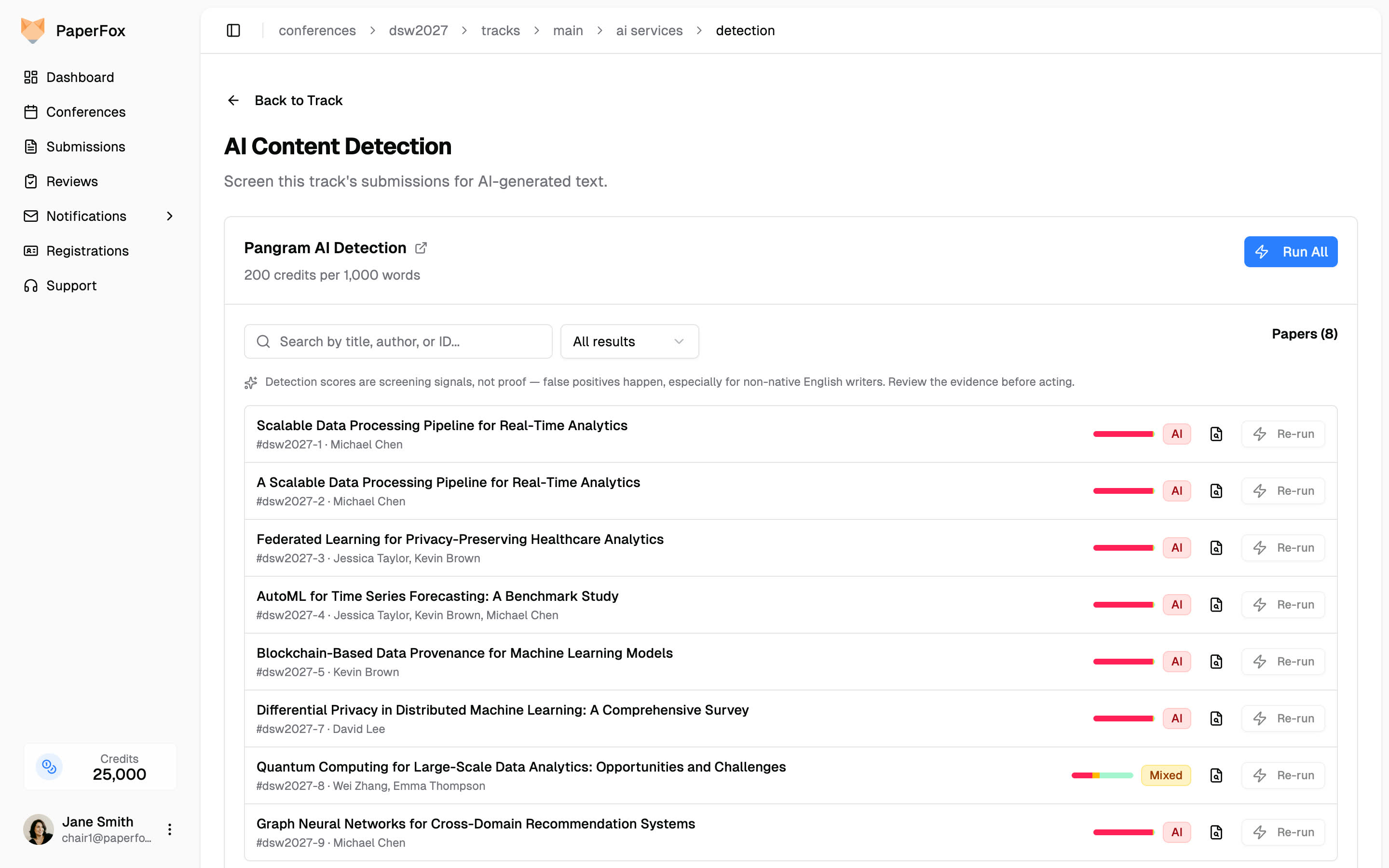
The service card shows the rate; every row shows its verdict and composition
The run happens in the background with a progress bar, so you can keep working. Each submission's row updates with:
- A verdict: AI (red), Mixed (amber), or Human (green)
- A composition bar showing what share of the text looks AI-generated, AI-assisted, and human-written, with exact percentages on hover
- A magnifier icon that opens the full evidence panel
On large tracks, a search box and a verdict filter (All, AI, Mixed, Human, Skipped, Not analyzed, each with live counts) narrow the list to the submissions worth your attention.
See the Evidence, Not Just the Number
Click the magnifier on any analyzed submission and PaperFox shows the flagged passages themselves, each with its label, score, and confidence level. Passages that look like humanized model output carry an extra Humanizer detected badge.
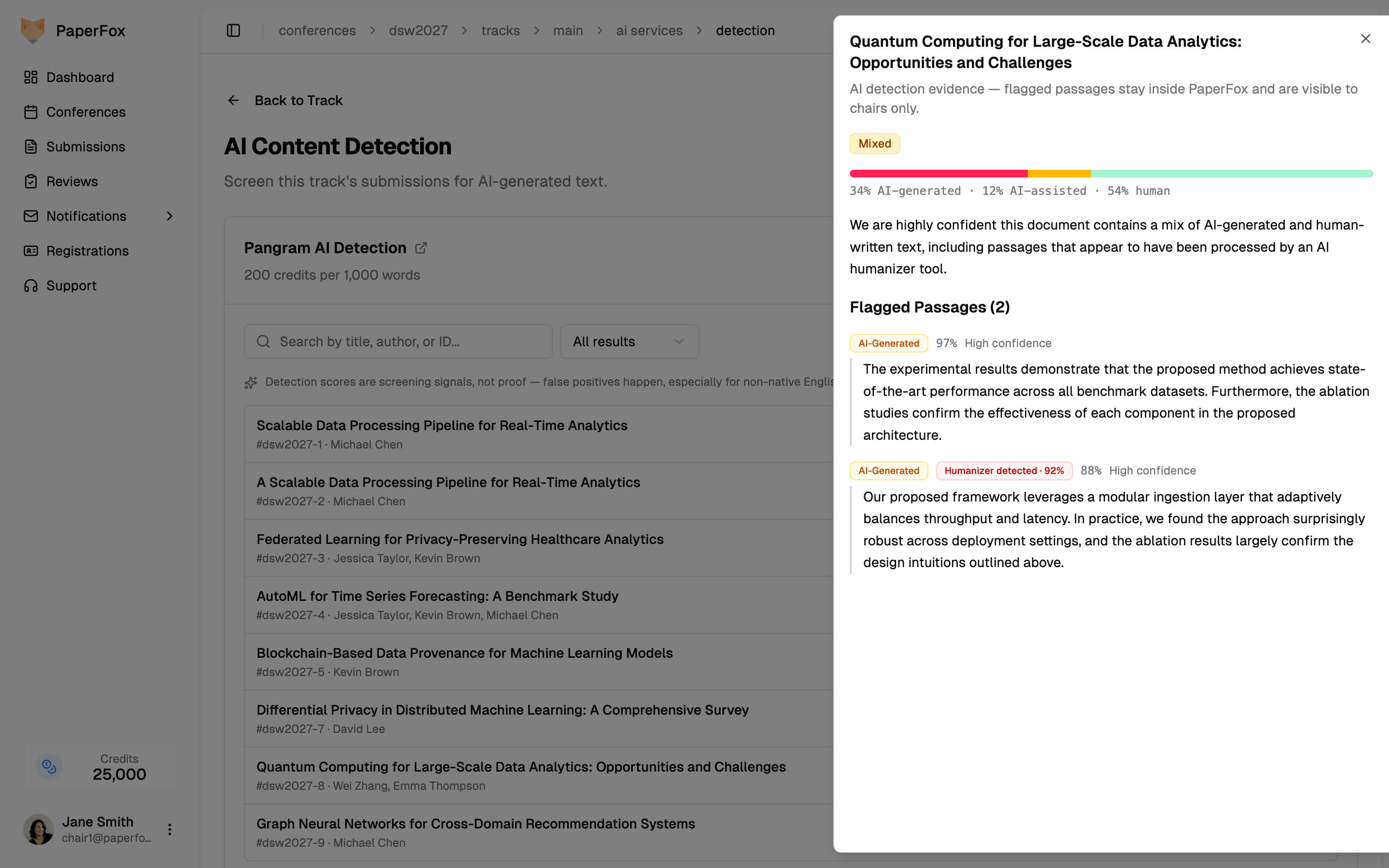
Flagged passages with their label, score, confidence, and humanizer status
A submission with a Human verdict simply has no flagged passages. The panel confirms nothing was flagged and you move on.
Privacy and Cost
Running detection is a chair's decision, and so is author consent: tell authors in your call for papers or submission terms that submissions may be screened for AI-generated text before you run it. On Pangram's side, submitted content is not used to train its models and the service is SOC 2 Type II certified; see Pangram's data privacy page for the details. Detection costs 200 credits per 1,000 words, about $6 for a typical 9,000-word submission. For comparison, Pangram's own API price is $0.50 per 1,000 words and PaperFox charges $0.67; the difference covers text extraction, the evidence panel, batch runs, and automatic refunds when the vendor fails. Unchanged submissions are never charged twice. The confirmation dialog shows the exact cost and the data disclosure before anything runs.
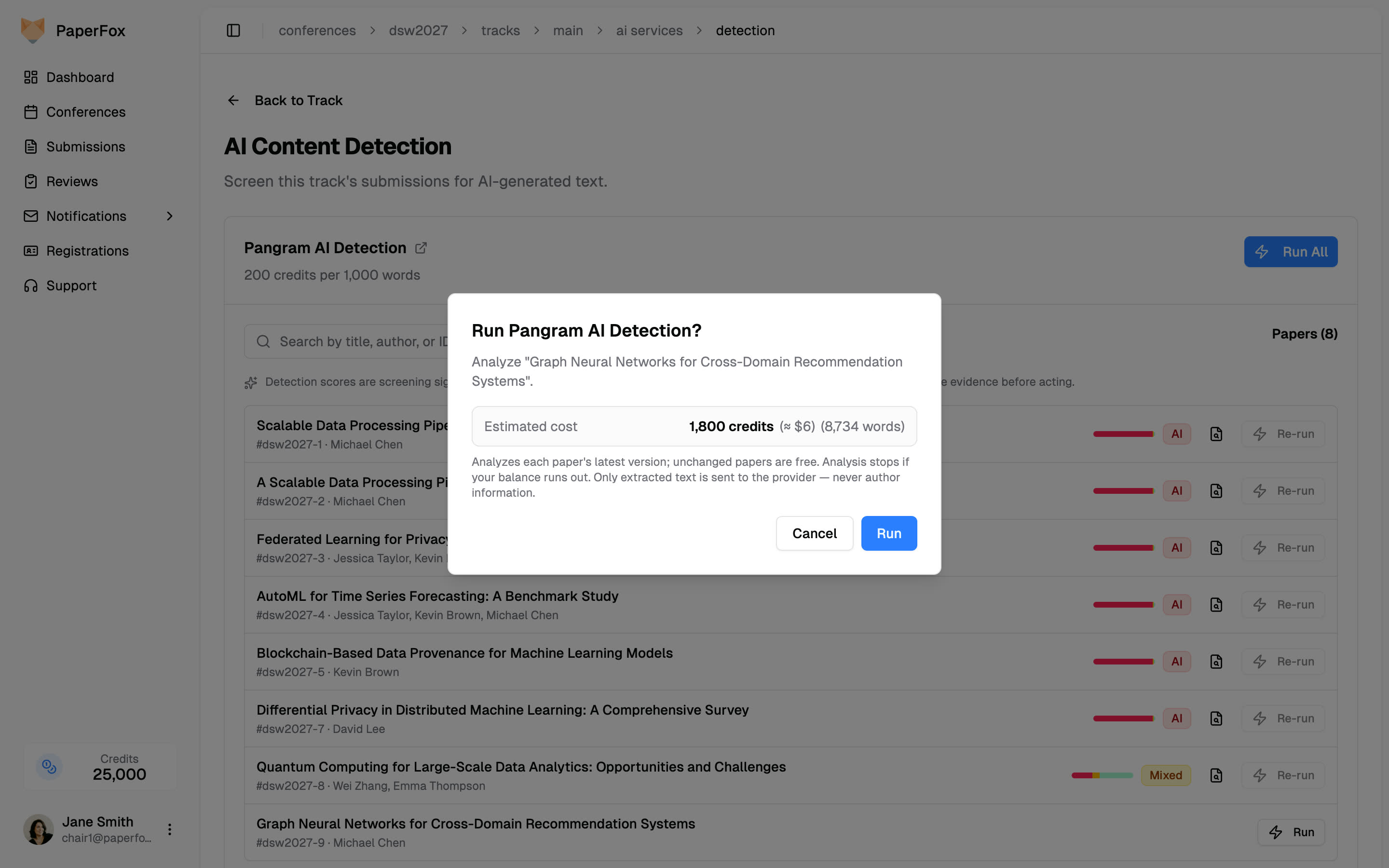
Exact cost from the submission's measured word count, plus the disclosure, before you confirm
A Signal, Not a Verdict
We want to be direct about the limits. AI detectors have documented false-positive risks, and non-native English writers are affected more than others. The NeurIPS chairs made the same point in their write-up: a Pangram score of 100% "should not be interpreted as '100% of the text is AI-generated'", only that AI was used substantively in many parts of it. A red row on the results page is a reason to read a submission more carefully. It is not a reason to reject it. Pair the score with the flagged passages, with the reviewers' own reading, and, when warranted, with a conversation with the authors.
Getting Started
AI Content Detection is available now on every track. Open your track, click AI Content Detection under Submission Management, and run it on a single submission first to see the results format. The documentation covers multi-file submission forms, which PDF version gets analyzed, and the full billing rules.