
Reviewer Workflow
The complete reviewer journey in PaperFox — from invitation to submitted review — plus guidelines for writing good reviews
This guide walks you through the reviewer experience end to end, with links to detailed how-tos for each step, and closes with guidelines for writing high-quality reviews.
Workflow at a Glance
- Respond to the reviewer invitation
- Complete your research profile
- Accept or decline paper assignments
- Write and submit your reviews
- Update a review or join the discussion
- Delegate to a sub-reviewer (if enabled)
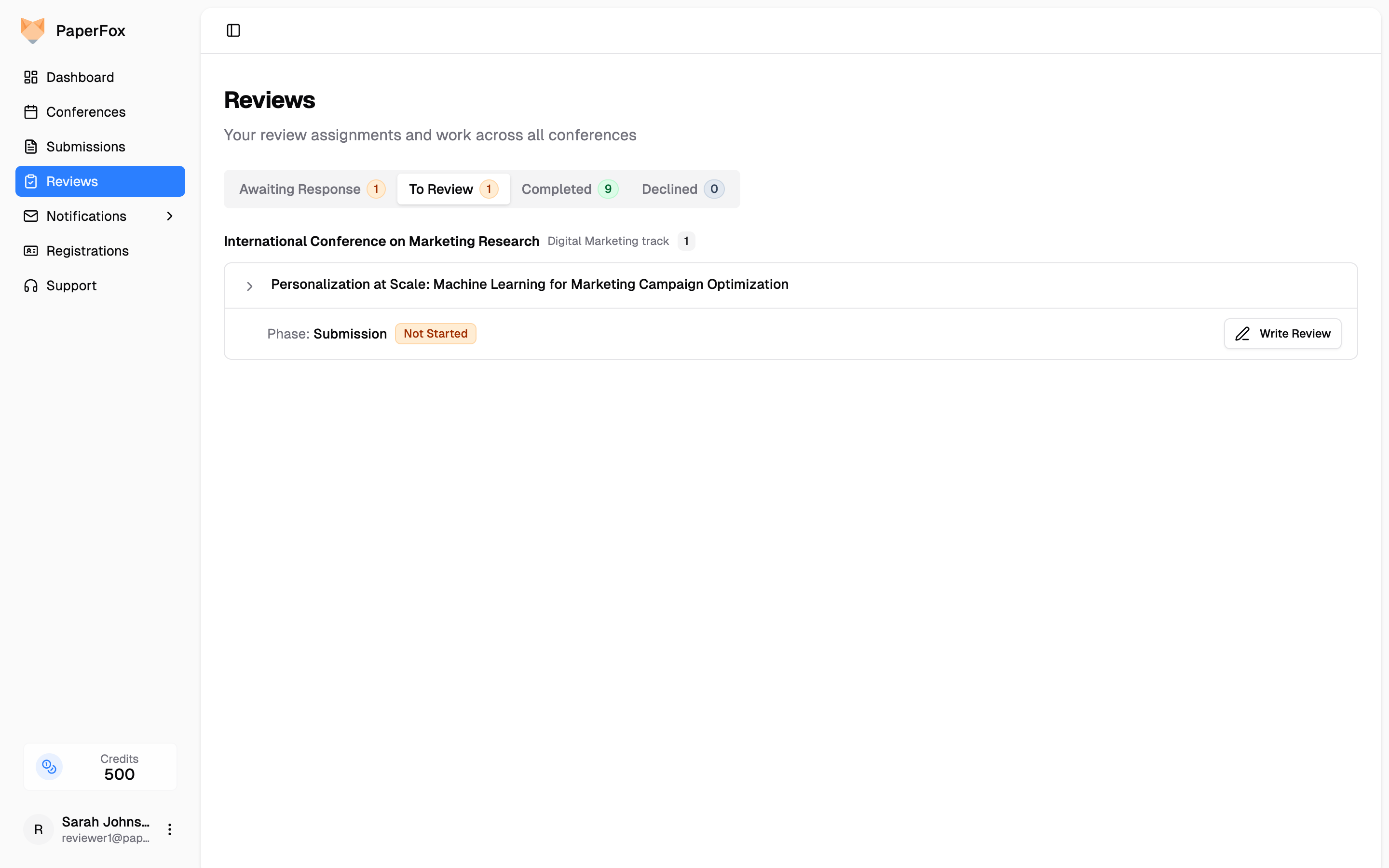
Everything happens on one page: click Reviews in the sidebar to see your invitations and reviews across all conferences, organized into Awaiting Response, To Review, Completed, and Declined tabs.
1. Respond to the Invitation
Track chairs invite you by email. The invitation names the conference and track — click the link to accept or decline (creating a PaperFox account first if you don't have one). Respond promptly either way: a quick decline lets the chair find another reviewer. See Managing Invitations.
Before accepting, check that the conference matches your expertise and that you have time for the review period.
2. Complete Your Research Profile
Add your expertise keywords in your Research Profile — chairs use them to match papers to you, so a complete profile means assignments you're actually qualified to review. Also declare any conflicts of interest so conflicted papers are never assigned to you.
3. Respond to Paper Assignments
When a chair assigns you a paper, it appears under Awaiting Response on the Reviews page (and you're notified by email). Expand the row to read the abstract, then Accept or Decline. Decline promptly if the paper is outside your expertise, you can't meet the deadline, or you have an undeclared conflict with the authors. See Manage Your Reviews.
4. Write and Submit Your Reviews
Accepted papers wait under To Review. Click "Write Review" to open the review editor: submission details and the PDF on the left, the review form on the right. The form's fields — ratings, comment boxes, optional file upload — are configured by the track chair, and on multi-phase tracks a Phase badge shows which review phase you're writing for.
Save your work as a draft anytime (drafts are private to you and sync across devices), and submit before the deadline. See Write and Update Reviews.
Whether you can see the authors' names depends on the track's review type: double-blind (identities hidden both ways), single-blind (you see authors; they don't see you), or open (both visible).
5. Update a Review or Join the Discussion
Submitted reviews move to Completed and can be revised until decisions are finalized — open the review, click "Update Review", and optionally add a revision note for the chairs. Each update is versioned in the review history. Chairs may also contact you to clarify your review or discuss papers where reviewers disagree — engage with other perspectives, explain your reasoning, and adjust your assessment if you're persuaded.
If the track enables author responses (rebuttal), a Discussion section appears on your review page. Authors post their response to the reviews there, and you can reply anytime — the response deadline binds only the authors:
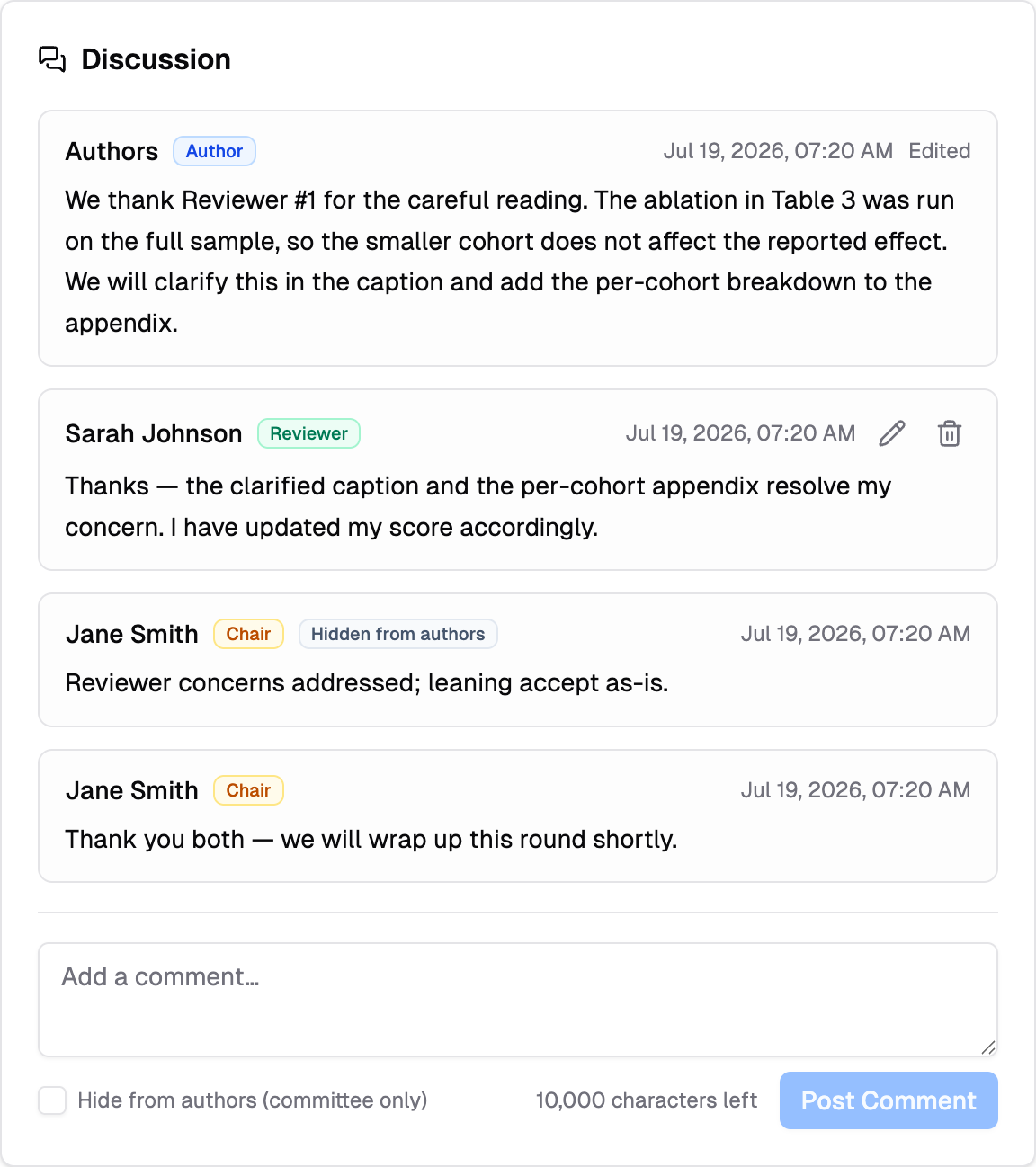
- On double-blind tracks, author comments appear as "Authors", and authors see you as "Reviewer #N" — matching your review's number, so don't reveal your identity in a comment.
- Check "Hide from authors (committee only)" to deliberate privately with the chairs and editors on the same thread.
- You can edit or delete your own comments: an edit shows an "Edited" marker (the committee can view earlier versions), and a deletion leaves a note in the thread.
- The typical loop: read the rebuttal, reply, then update your review if the response changed your assessment.
6. Delegate a Review (Optional)
If the track allows sub-reviewers and you can't complete an assignment yourself, you can delegate it to a qualified colleague and stay responsible for the result. See Delegate a Review.
Review Guidelines
What to Evaluate
- Technical quality — Is the methodology sound? Are the conclusions supported by the evidence? Could the work be reproduced?
- Novelty and significance — What is new here, and how much does it advance the field?
- Clarity — Is the paper well-organized and understandable, with readable figures and tables?
- Fit — Does the work match the track's scope, and will the audience find it valuable?
Writing a Good Review
Structure your comments as a brief summary of the contribution (showing you understood the work), followed by specific strengths and weaknesses, then detailed suggestions.
- Be constructive — focus on how to improve the work; suggest fixes, not just faults
- Be specific — point to sections, figures, or claims; explain the reasoning behind each criticism
- Be balanced — acknowledge what's good even in a paper you recommend rejecting
- Be professional — critique the work, never the authors; in double-blind review, don't reveal your identity in your comments
Allow a few focused hours per paper, and start early enough to submit before the deadline. If you're falling behind, tell the track chair rather than going silent.
Ethics
- Confidentiality — never share or discuss a submission outside the review process, and don't use its ideas in your own work before publication
- Conflicts of interest — decline (or report to the chair) any paper by a recent collaborator, colleague at your institution, or anyone you can't judge objectively; see Managing Conflicts of Interest
- Fairness — judge the work on its merits alone
Ready to begin? Check Reviews for pending invitations and papers waiting on your review.