
Create Conference Website
Complete guide to building and customizing your conference's public website
This guide will help you create a professional conference website using PaperFox. You'll learn how to set up submissions, showcase your event, and provide attendees with all the essential information.
Getting Started
Step 1: Access the Website Builder
From your dashboard:
- Go to your conference dashboard
- Click the conference you want to manage
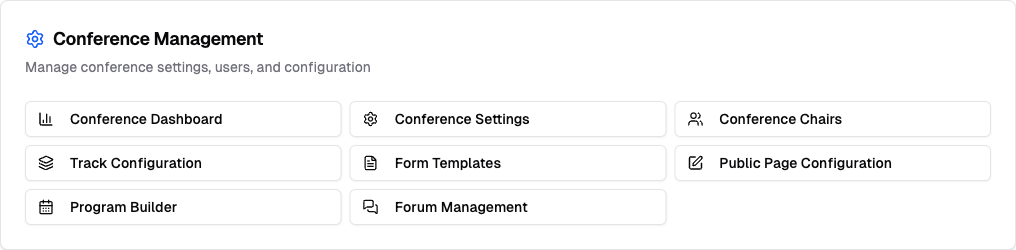
- Click "Public Page Configuration" in the Conference Management section
Step 2: Choose Your Website Approach
PaperFox offers two approaches for your conference website:
Option A: Built-in Page Editor (Recommended)
- Best for: Most conferences
- Features: Drag-and-drop editor, rich content tools, integrated submissions
- Benefits: Easy to maintain, automatically handles submissions, mobile-optimized
Option B: External Website
- Best for: Conferences with existing websites
- Features: Link to your custom website
- Benefits: Complete design control, use existing infrastructure
If you choose Option B, you will not be able to use the built-in page editor.
Landing Page Customization
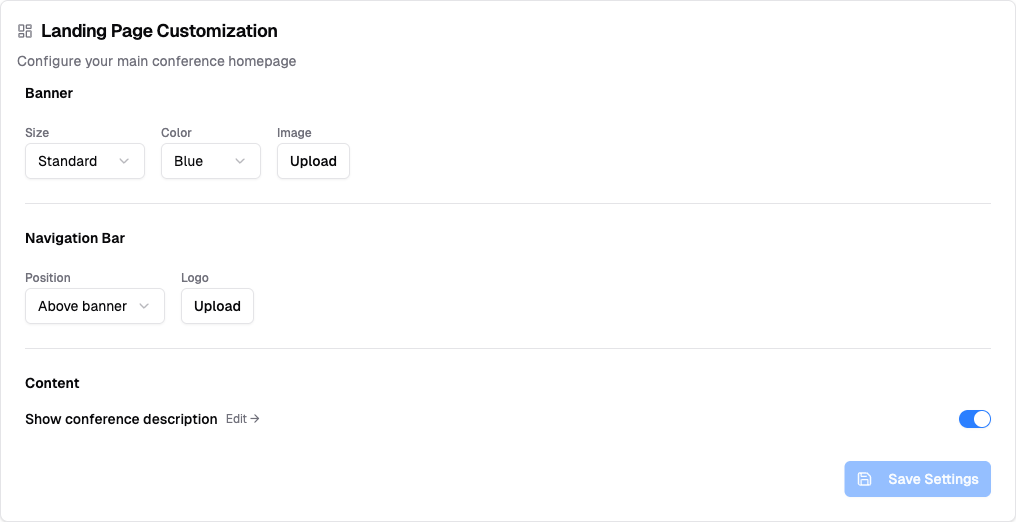
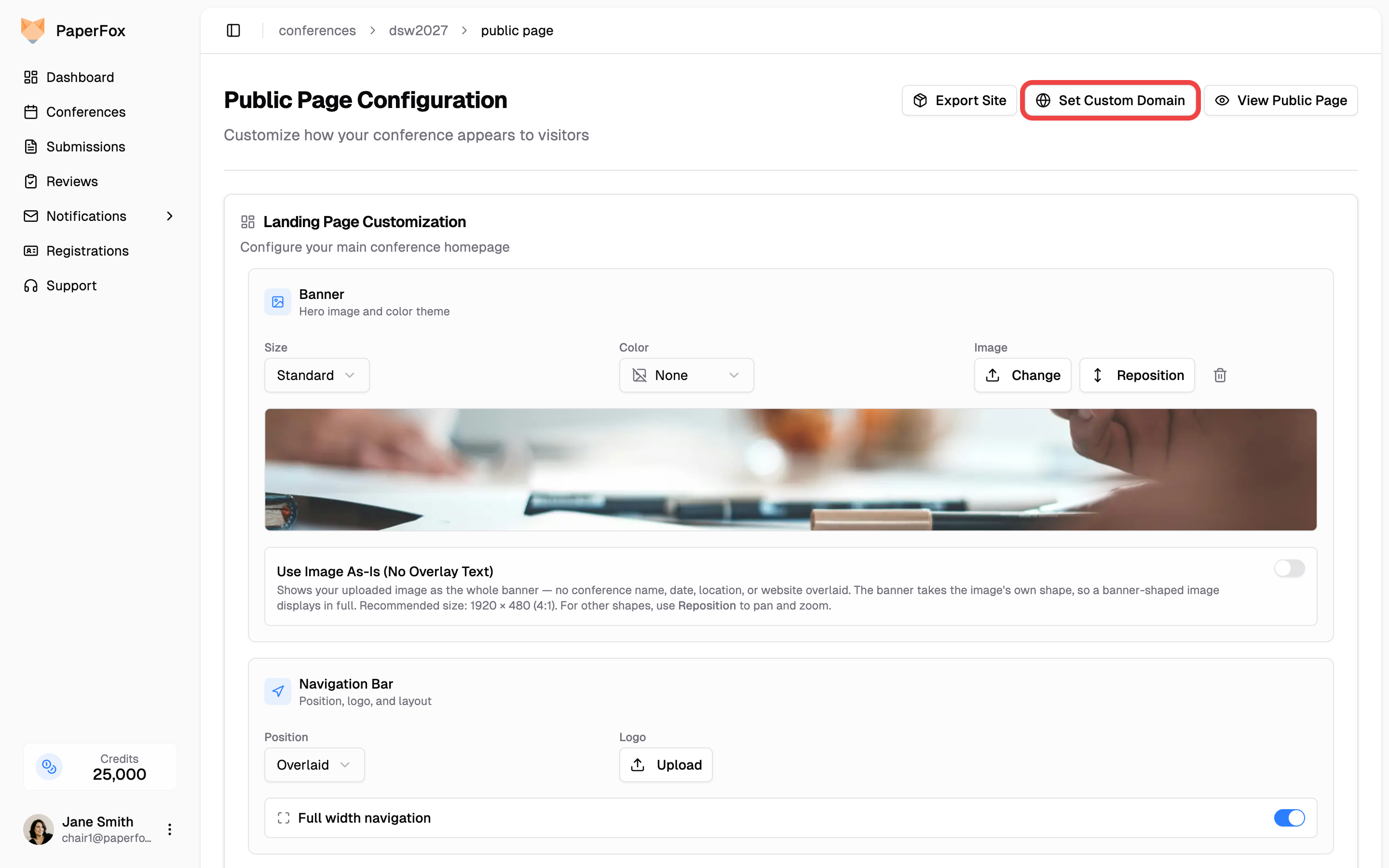
The Landing Page Customization card lets you configure your main conference homepage appearance.
Banner
Configure the visual header of your landing page:
- Size: Choose from Compact, Standard, or Full Screen
- Color: Select from 22 professional color themes with color swatches
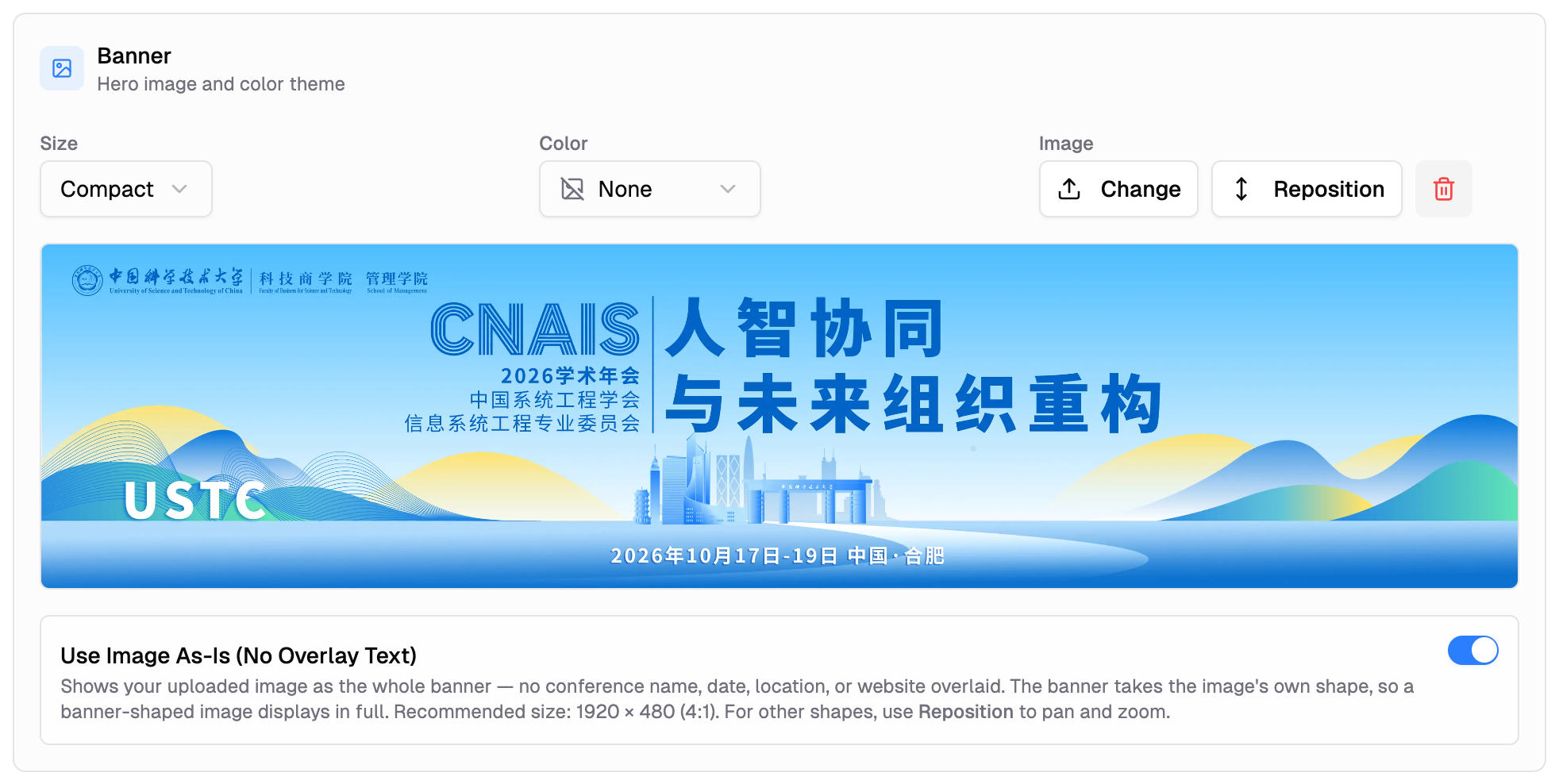
- Image: Upload a custom banner image (optional). After uploading, you can reposition the focal point using the cropper dialog to ensure the most important part of your image stays visible at different screen sizes.
- Use Image As-Is (No Overlay Text): Toggle that appears after uploading an image. When enabled, your uploaded image becomes the whole banner — the conference name, date, location, and website link are hidden. The banner takes the image's own shape, so a banner-shaped image displays in full with no crop or stretch. Recommended upload size is 1920 × 480 (4:1). For images that aren't banner-shaped, use Reposition to pan and zoom within the frame.
Navigation Bar
Control how the navigation appears on your site:
- Position: Choose where the navigation bar appears — "Above banner" or "Overlaid" on top of the banner. Full Screen banners require overlaid navigation.
- Logo: Upload your conference logo to display in the navigation bar
- Logo size: Choose Small, Medium, or Large (appears after uploading a logo)
- Full width navigation: Toggle to make the navigation bar span the full width of the page
Content
- Show conference description: Toggle whether to display your conference description on the landing page. Click "Edit →" to update the description in Conference Settings.
Click "Save Settings" to apply your changes.
Using the Page Editor
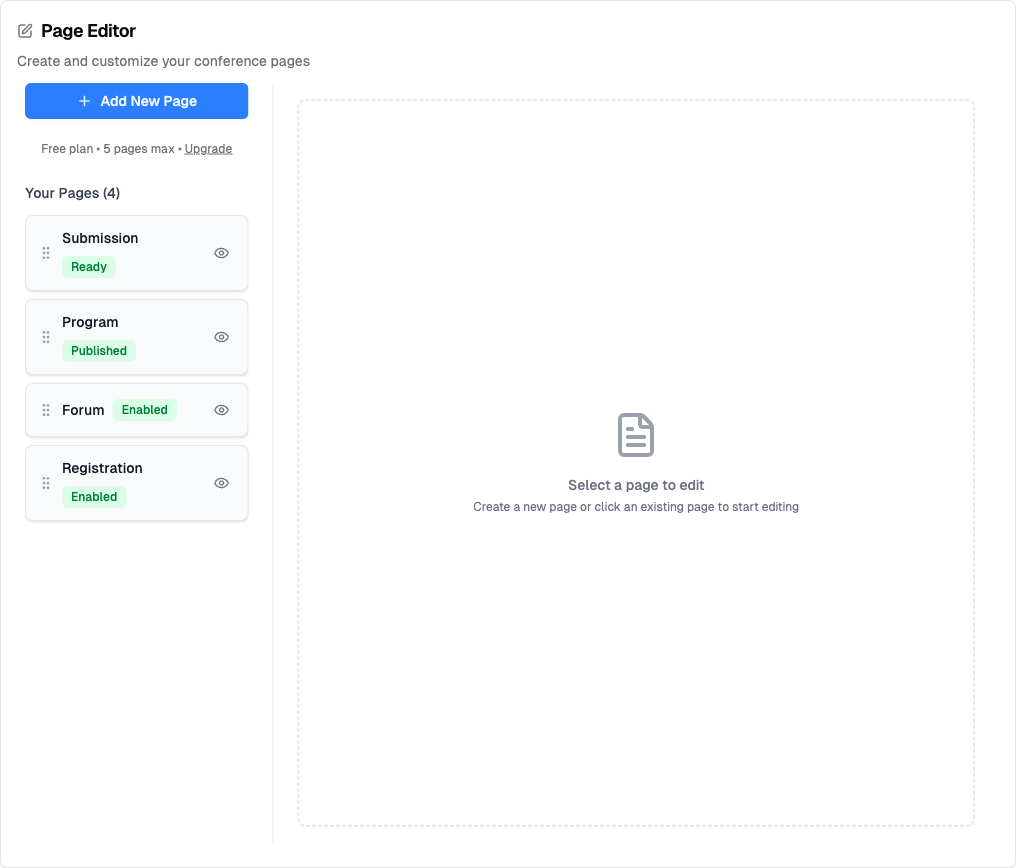
The Page Editor allows you to create and customize your conference pages.
System Pages (Built-in)
Your website includes five system pages that connect to core features:
| Page | Status Badge | Description |
|---|---|---|
| Home | — | Landing page with banner, conference info, and description. |
| Submission | Ready | Lists tracks with deadlines. Authors submit submissions here. |
| Program | Published | Displays sessions by day with search and mobile app support. |
| Registration | Enabled | Sign-up forms with registration types and Stripe payments. |
| Forum | Enabled | Discussion threads for attendees to connect. |
System pages show a status badge indicating whether the feature is ready.
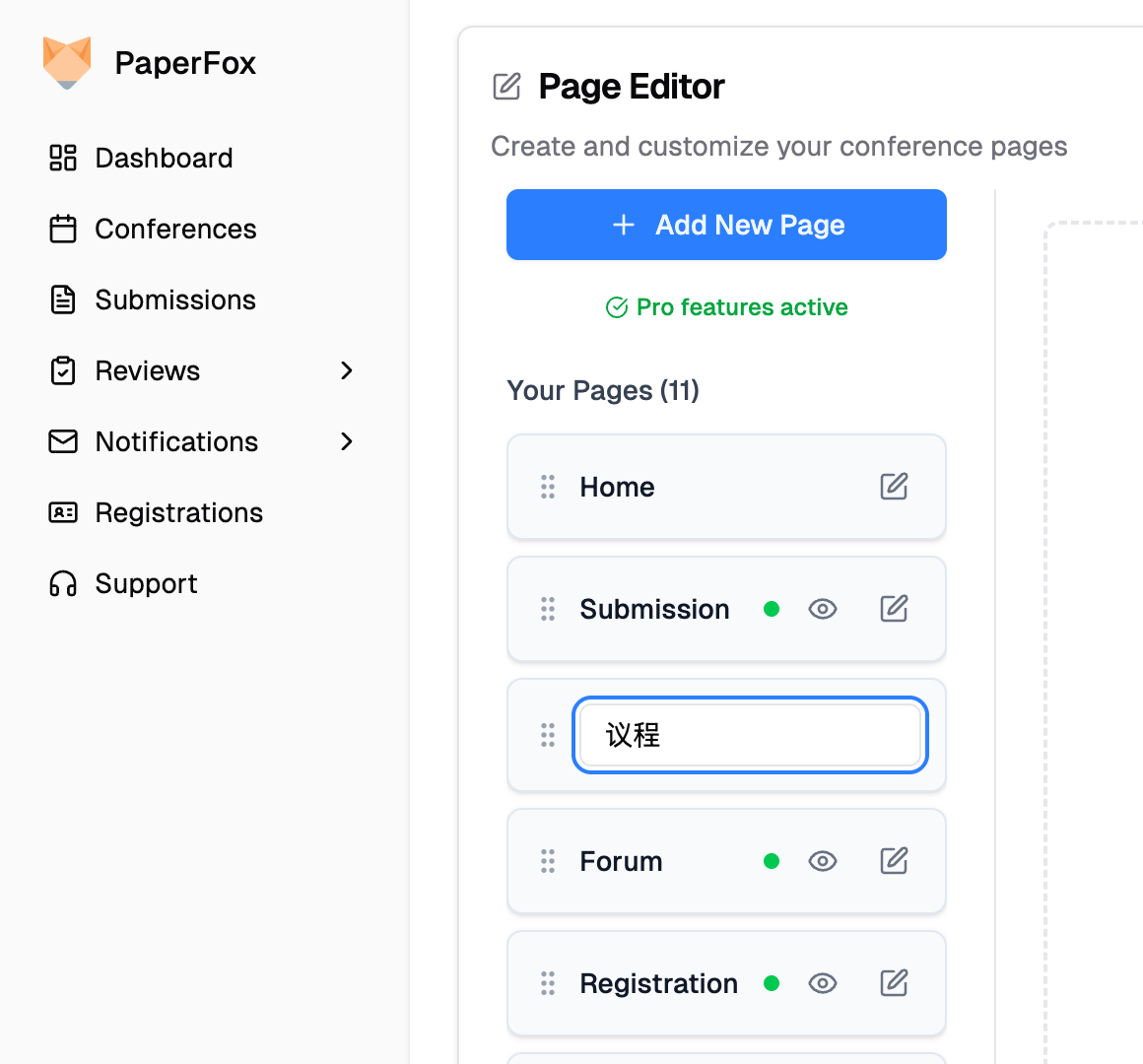
Renaming a system page
Click the pencil ✏ button next to any system page to change the label that appears in your menu. Labels can be any language — Chinese, Japanese, Cyrillic, emoji — they all work:
- "Submission" → "提交"
- "Program" → "プログラム"
- "Registration" → "Регистрация"
The page's URL never changes. Renaming only updates the menu label visitors see.
Creating Custom Pages
- Click "Add New Page" in the Page Editor
- The new page appears in your page list
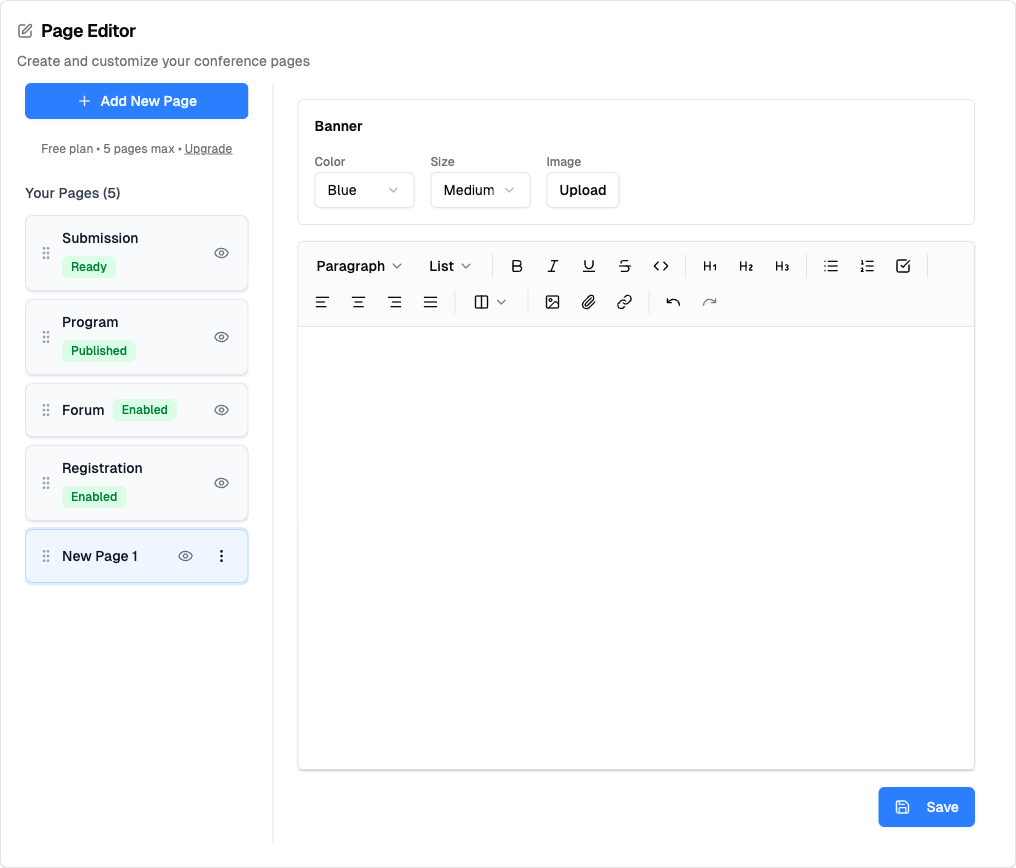
- Configure page-specific banner settings (Color, Size, Image)
- Use the rich text editor to add content
- Click "Save" to save your changes
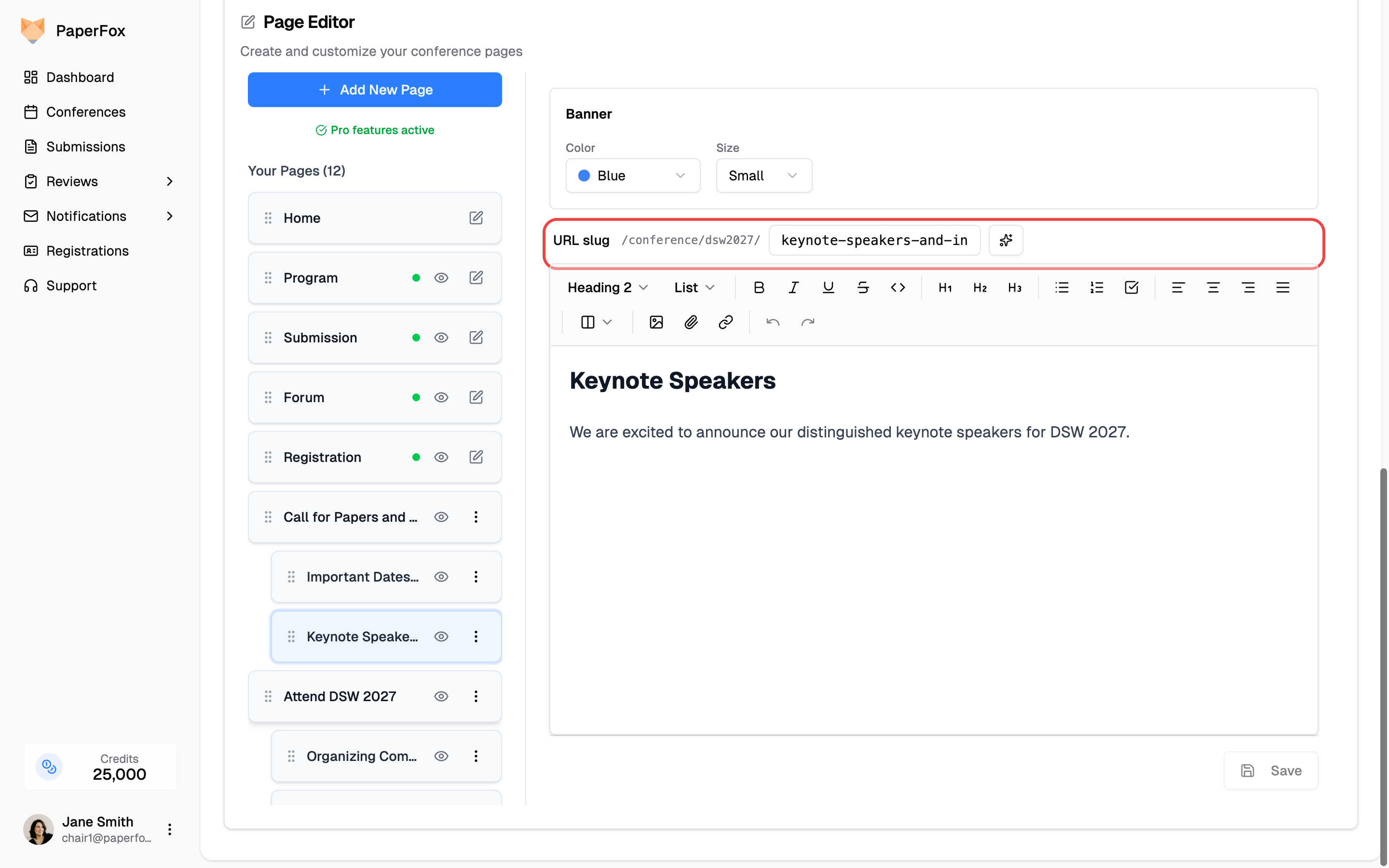
Editing the URL slug
Above the rich text editor, custom pages have a URL slug field that controls the page's web address (e.g. /conference/dsw2027/agenda). Slugs must be lowercase ASCII — letters, numbers, and hyphens only. Edit the field and click outside to save.
If you renamed the page label to a non-English language, click the ✨ button next to the slug field and PaperFox will translate the label into a clean English slug ("议程" → agenda, "プログラム" → program). You can edit the suggestion before it commits.
Rich Content Editor
The built-in editor supports:
Text Formatting:
- Headers (H1–H3)
- Bold, italic, underline, strikethrough
- Bullet points, numbered lists, and checklists
- Text alignment (left, center, right, justify)
- Code blocks
Media Integration:
- Images: Upload and resize images
- Links: Add links to external websites and resources
- File Attachments: Upload PDFs, documents, and other files
Page Organization
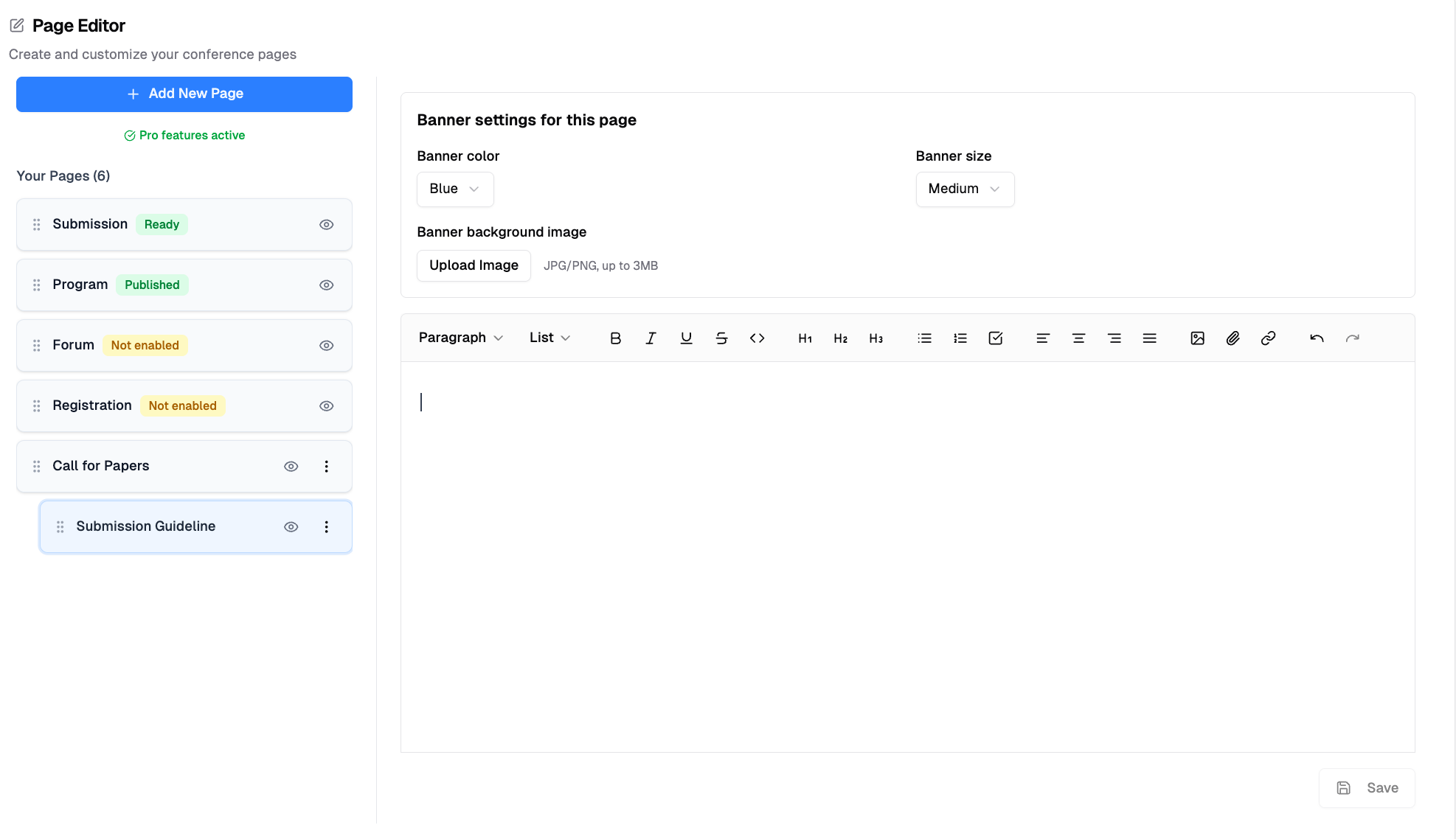
- Drag and drop pages to reorder navigation
- Create submenus by dragging pages below other pages
- Maximum 5 main pages and 5 submenu items per section
Page Visibility
Control which pages appear in your navigation by clicking the visibility toggle (eye icon) on any page.
- Your own pages are taken off the site entirely — they leave the menu, and anyone who opens the address sees a "not available" notice.
- Built-in pages (Submission, Program, Forum, Registration, Registrants) only leave the menu. Their addresses keep working, so a link you already shared still opens.
Home cannot be hidden — it's the conference's landing page and always appears first in navigation.
Draft Pages
To work on one of your own pages before anyone sees it, open the ⋮ menu on that page and click "Unpublish". The page keeps a Draft badge in the editor, and visitors get a "not available" notice instead of the content. Click "Publish" on the same menu to make it live.
Built-in pages don't use drafts — each one is controlled by its own feature setting instead.
Preview Your Changes
You can always preview your website by clicking "View Public Page" in the top right to see how your changes will look to visitors.

Use a Custom Domain
By default your conference website lives at paperfox.ai/conference/your-slug. The Custom Domain add-on serves the same site from an address you own — for example 2027.yourconference.org — so links, posters, and call-for-papers emails all point at your own brand.
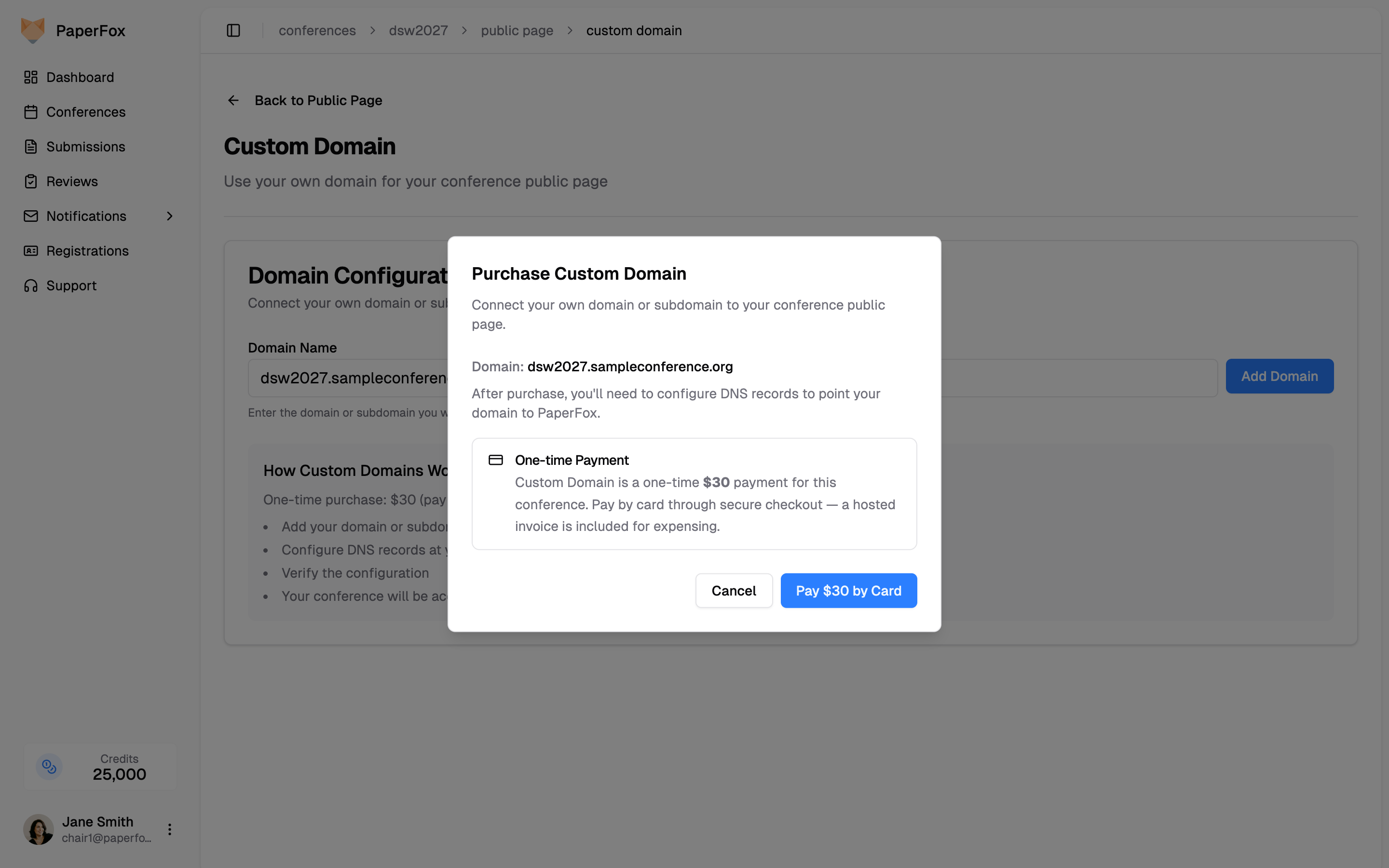
Custom Domain is a one-time $30 purchase per conference, paid by card with a hosted invoice for expensing.
Before You Start
- You must be a conference chair for the conference.
- You must already own the domain, and be able to add DNS records at whoever manages it — your registrar (Namecheap, GoDaddy, Cloudflare) or your university IT department.
- Decide which address you want:
- A subdomain like
2027.yourconference.org— recommended, and the easiest to set up. - An apex domain like
yourconference.org— works too, but uses a different DNS record type.
- A subdomain like
Step 1: Open the Custom Domain Page
- Go to Conferences in the sidebar, then click on your conference
- Click "Public Page Configuration" in the Conference Management section
- Click "Set Custom Domain" in the top-right actions bar
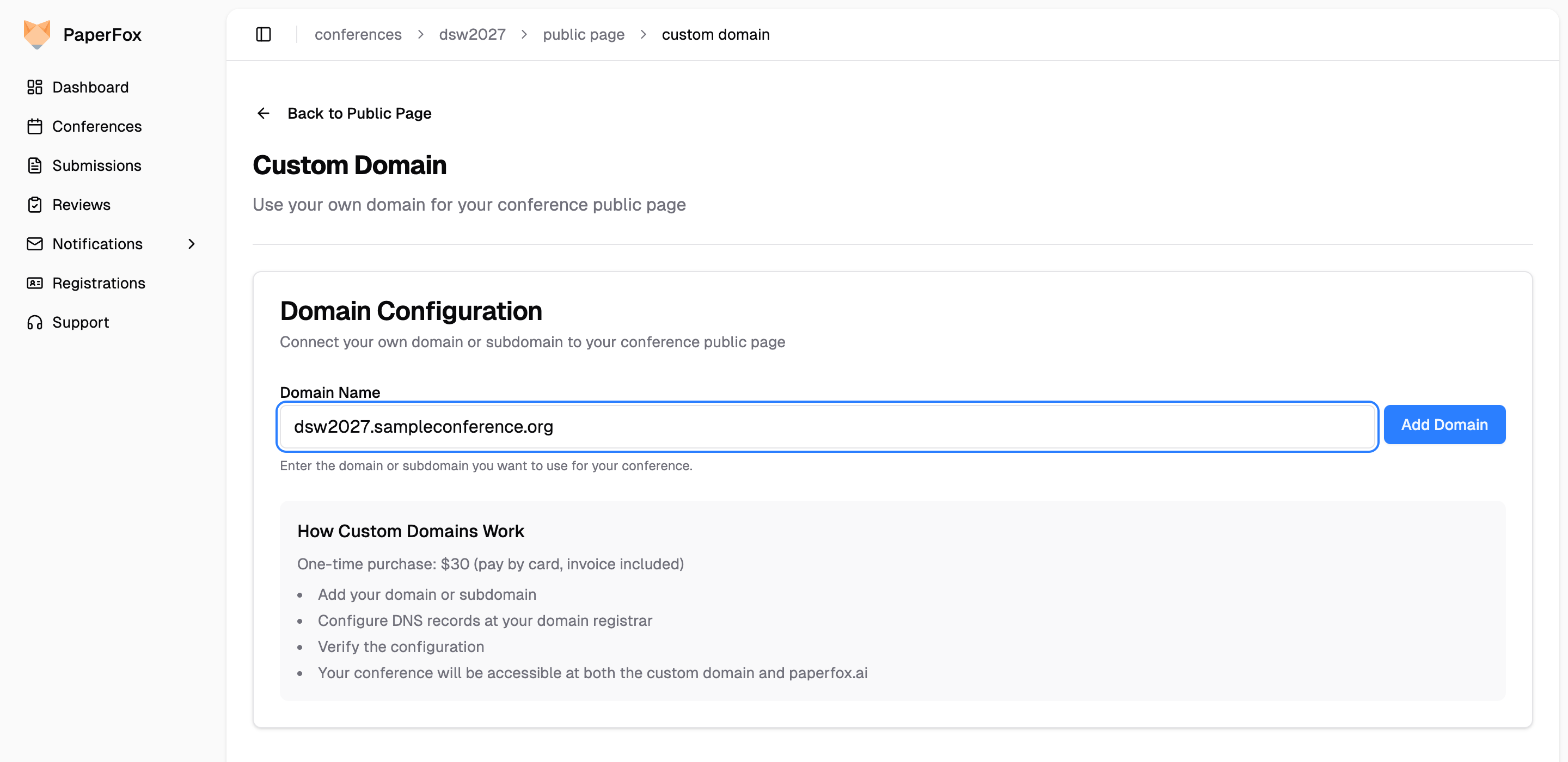
Step 2: Add Your Domain
- Type the address you want to use in the Domain Name field — enter it without
https://, for example2027.yourconference.org - Click "Add Domain"
The first time you do this, the Purchase Custom Domain dialog opens. Click "Pay $30 by Card" to go to secure Stripe checkout.
After payment you return to this page and a green Feature Purchased badge appears in the header. Enter your domain again and click "Add Domain" — payment unlocks the feature, it doesn't save the domain for you.
Step 3: Add the DNS Records
Once the domain is added, PaperFox shows exactly which DNS records to create. Each value has a copy button next to it.
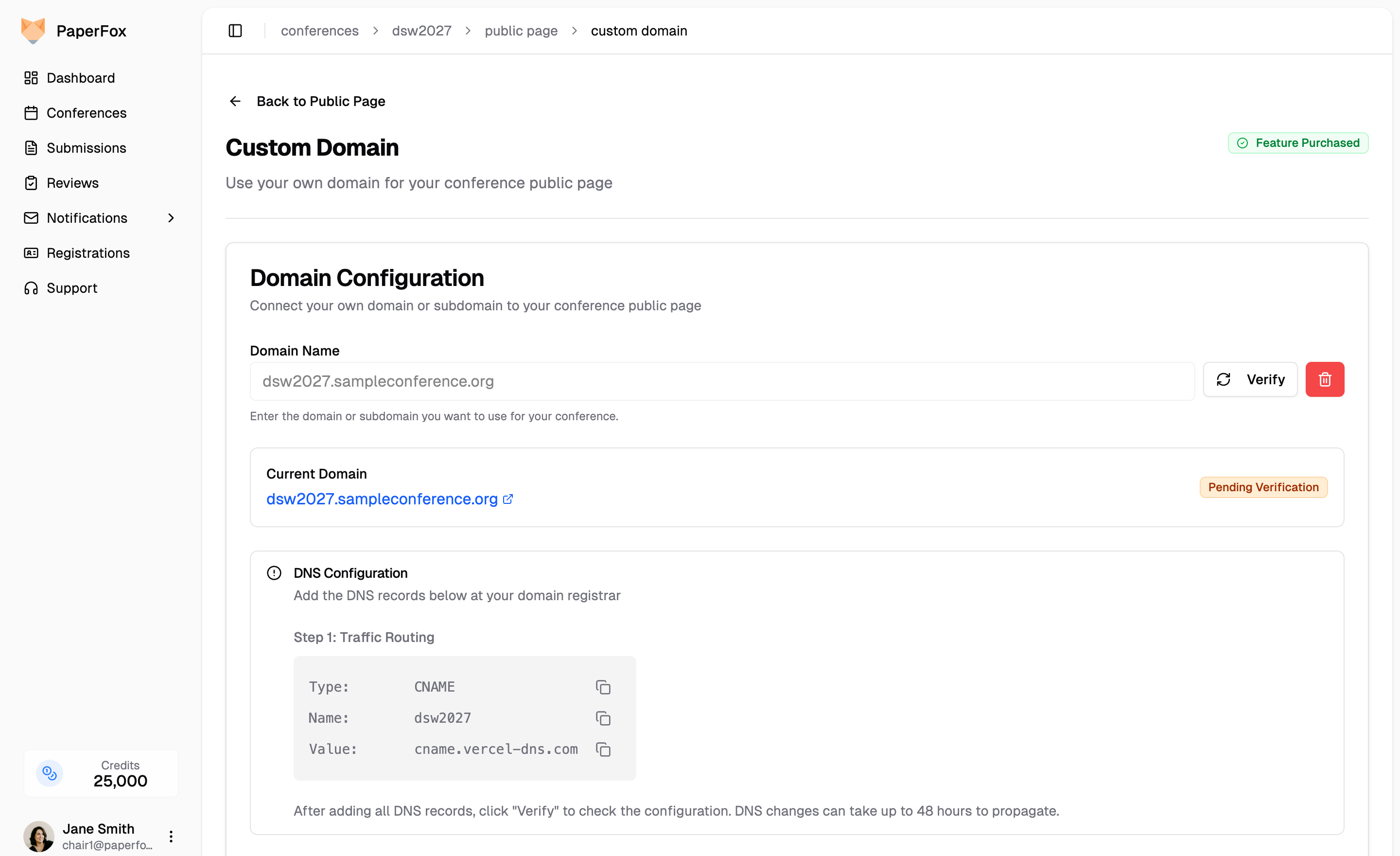
The record you get depends on the kind of address you chose:
| Your domain | Type | Name | Value |
|---|---|---|---|
Subdomain (2027.yourconference.org) | CNAME | the subdomain (2027) | cname.vercel-dns.com |
Apex domain (yourconference.org) | A | @ | 76.76.21.21 |
Add the record at your registrar exactly as shown. If a second record appears under Step 2: Domain Verification, add that TXT record too — it proves you control the domain, and verification will not pass without it.
Where do I add these?
Every registrar calls this screen something slightly different — "DNS", "DNS Management", "Advanced DNS", or "Zone Editor". If your domain is managed by your university or institution, send them the table above; it's all they need.
Step 4: Verify
After the records are saved at your registrar, come back to this page and click "Verify".
- If the records are live, the status changes to Verified and your conference is reachable at your domain.
- If not, you'll see a message that DNS isn't configured yet. This is normal — DNS changes can take up to 48 hours to propagate. Wait and click "Verify" again.
Your domain only starts serving the conference after it reaches Verified status.
| Badge | What it means |
|---|---|
| Pending Verification | The domain is added, but the DNS records aren't visible yet. Add the records, then click "Verify". |
| Verified | DNS is correct and your conference is live at the custom domain. |
| Failed | The verification check hit an error. Re-check the records against the table above and click "Verify" again. |
After It's Live
- Both addresses keep working — visitors can reach your conference at your custom domain and at
paperfox.ai/conference/your-slug. - Paths carry over:
2027.yourconference.org/programshows your program page,/registershows registration, and so on. - HTTPS is set up for you. There's no certificate to buy or renew.
Changing or Removing the Domain
Click the red trash button next to Verify to remove the current domain. Your conference stays available at its paperfox.ai address, and you can add a different domain afterwards — the $30 feature purchase stays with the conference, so switching domains later costs nothing.
Removing is not a refund
Removing a domain frees it for reuse, but the one-time purchase is non-refundable. Any posters, emails, or links already pointing at the removed address will stop working.
Custom Domain Troubleshooting
"Domain is already in use by another conference" — each domain can serve only one PaperFox conference. Remove it from the other conference first, or pick a different subdomain.
Verify keeps saying DNS isn't configured — check that the record Name matches exactly what PaperFox shows (many registrars auto-append your domain, so entering 2027.yourconference.org can become 2027.yourconference.org.yourconference.org). Also make sure there's no older A, CNAME, or parking record on the same name conflicting with the new one.
The domain loads someone else's site — an old record is still cached. Give it the full 48 hours before assuming something is wrong.
Export as Static Site
Export your conference website as a zip of static HTML files. The exported site works fully offline and can be uploaded to GitHub Pages, Netlify, or any static hosting as a permanent backup.
What Gets Exported
| Included | Details |
|---|---|
| Home page | Your landing page with banner, conference info, and description |
| Custom pages | All pages you created in the Page Editor |
| CSS | All styles inlined — no external dependencies |
| Images | Banner, logo, and content images downloaded locally |
| Navigation | Static nav bar linking all pages together |
System pages link to the live site
System pages (Submission, Program, Forum, Registration) require server functionality, so they link back to your live PaperFox site instead of being exported as static files.
How to Export
- Go to Conferences in the sidebar, then click on your conference
- Click "Public Page Configuration" in the Conference Management section
- Click the "Export Site" button in the top-right actions bar

- A zip file will download automatically (e.g.,
dsw2027-static-site.zip) - Unzip and open
index.htmlin your browser to view the site
Hosting Your Exported Site
GitHub Pages
- Create a new GitHub repository
- Upload all the exported files (HTML files +
assets/folder) - Go to Settings → Pages and set the source to the main branch
- Your site will be live at
https://username.github.io/repo-name
Netlify / Other Static Hosts
Simply drag and drop the unzipped folder into Netlify's deploy interface, or upload to any static file hosting service.
Export reflects current state
The export captures your public pages as they are right now. If you update your conference website later, you'll need to export again to get the latest version.