
Run AI Writing Detection
Screen submissions for AI-generated text with external AI services, paid in credits
PaperFox can run external AI analysis on a track's papers. The first analysis type is AI Writing Detection, powered by Pangram AI Detection, which scores how much of each paper's text looks AI-generated. More analysis types and vendors will be added over time.
Papers are sent to an external provider
Unlike compliance checks, which run entirely inside PaperFox, AI services send each paper's extracted text to the external provider for analysis. No author information is ever included — text only.
How It Works
- Pick a service — Each service card shows the vendor and its per-word rate
- Confirm the charge — The confirmation dialog shows the estimated cost before anything runs
- Run in the background — PaperFox extracts each paper's text and sends it for analysis
- Review results — Per-paper verdicts, scores, and in-app evidence showing the flagged passages
Available Services
| Service | Page | Cost | Status |
|---|---|---|---|
| Pangram AI Detection | AI Writing Detection | 20 credits per 1,000 words | Available |
Credits and Pricing
AI services are pay-as-you-go: each paper is charged from its actual length as it's analyzed — a typical 9,000-word paper costs about 180 credits, a short paper costs less.
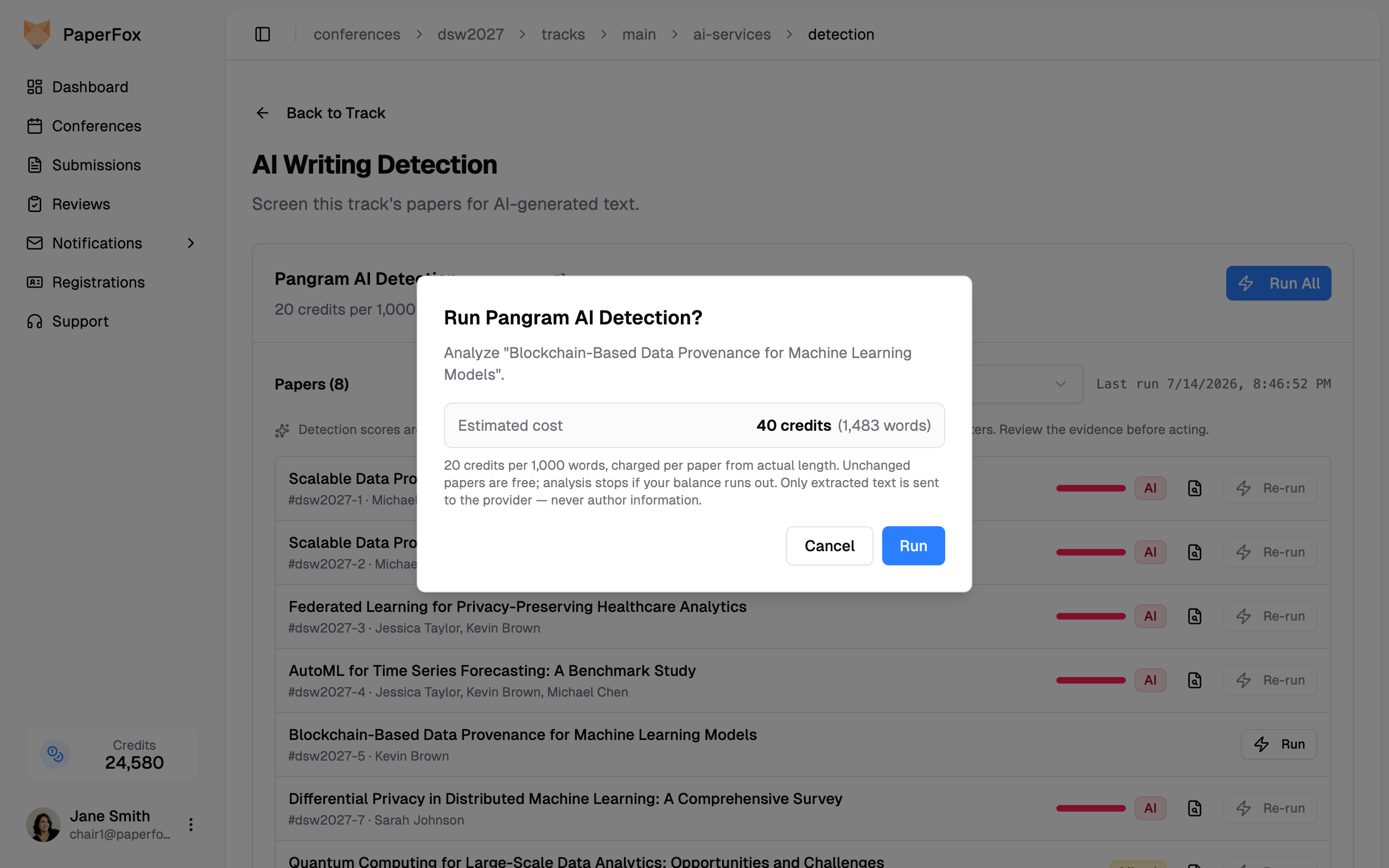
- The service card shows the rate; the confirmation dialog shows the estimated cost — an exact per-paper figure from the paper's measured word count for a single-paper run, an approximate total for Run All
- Papers are charged one at a time, as each is analyzed — you're never charged for a paper that wasn't analyzed
- Unchanged papers are free — if a paper's text is identical to a previous run, the earlier result is reused at no charge. A paper whose current text already has a result can't be re-run at all (its Re-run button is disabled — there's nothing new to analyze)
- If your balance runs out mid-run, analysis stops automatically — already-analyzed papers keep their results, the rest are marked "insufficient credits," and running again after a top-up picks up exactly where it stopped (the analyzed papers reuse for free)
- Papers that fail on the provider's side after being charged are refunded automatically
- Starting a run requires enough balance for at least one typical paper
Running Detection
- Go to Conferences in the sidebar, then click on your conference
- Navigate to your track and under Submission Management, click "AI Writing Detection"
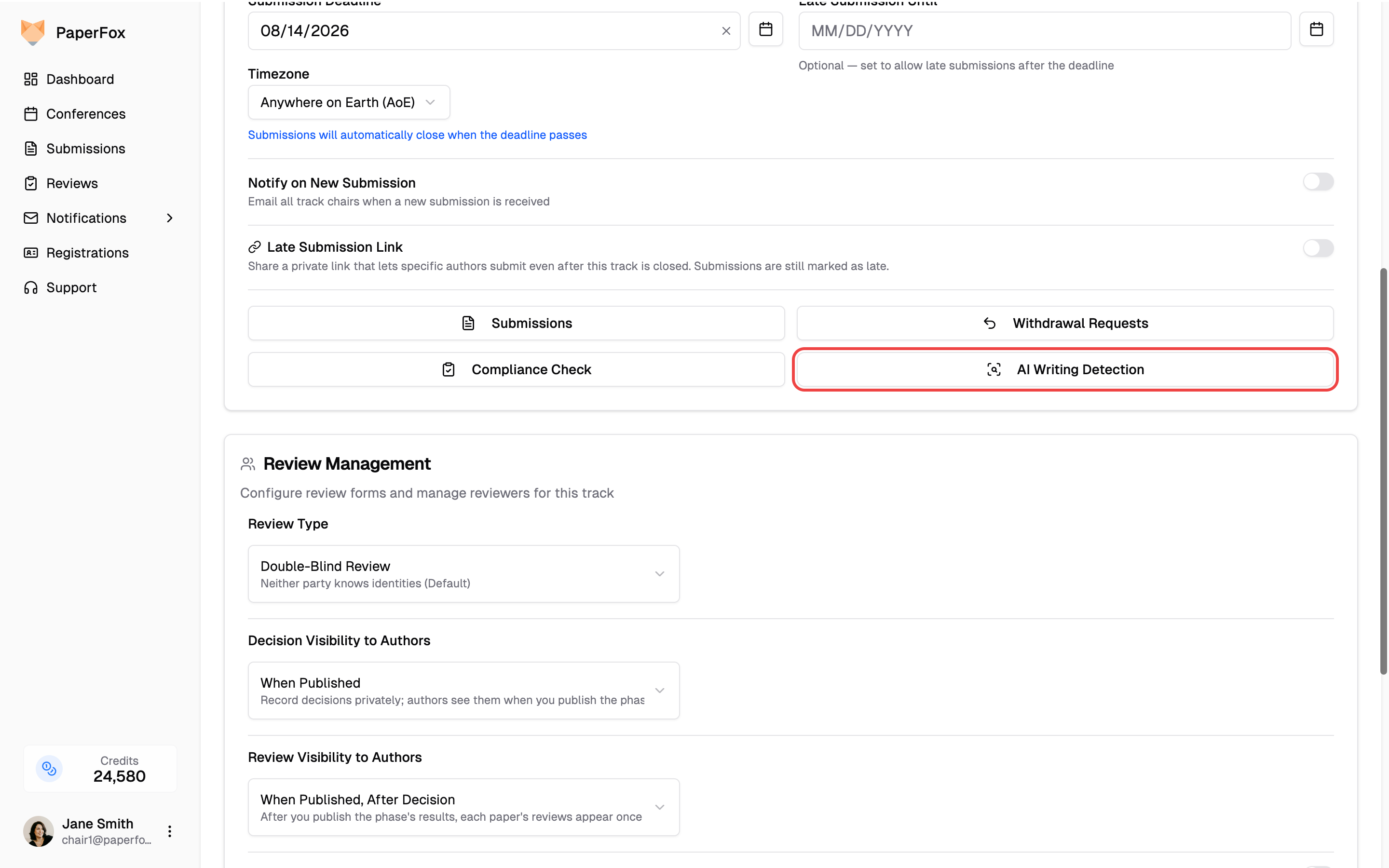
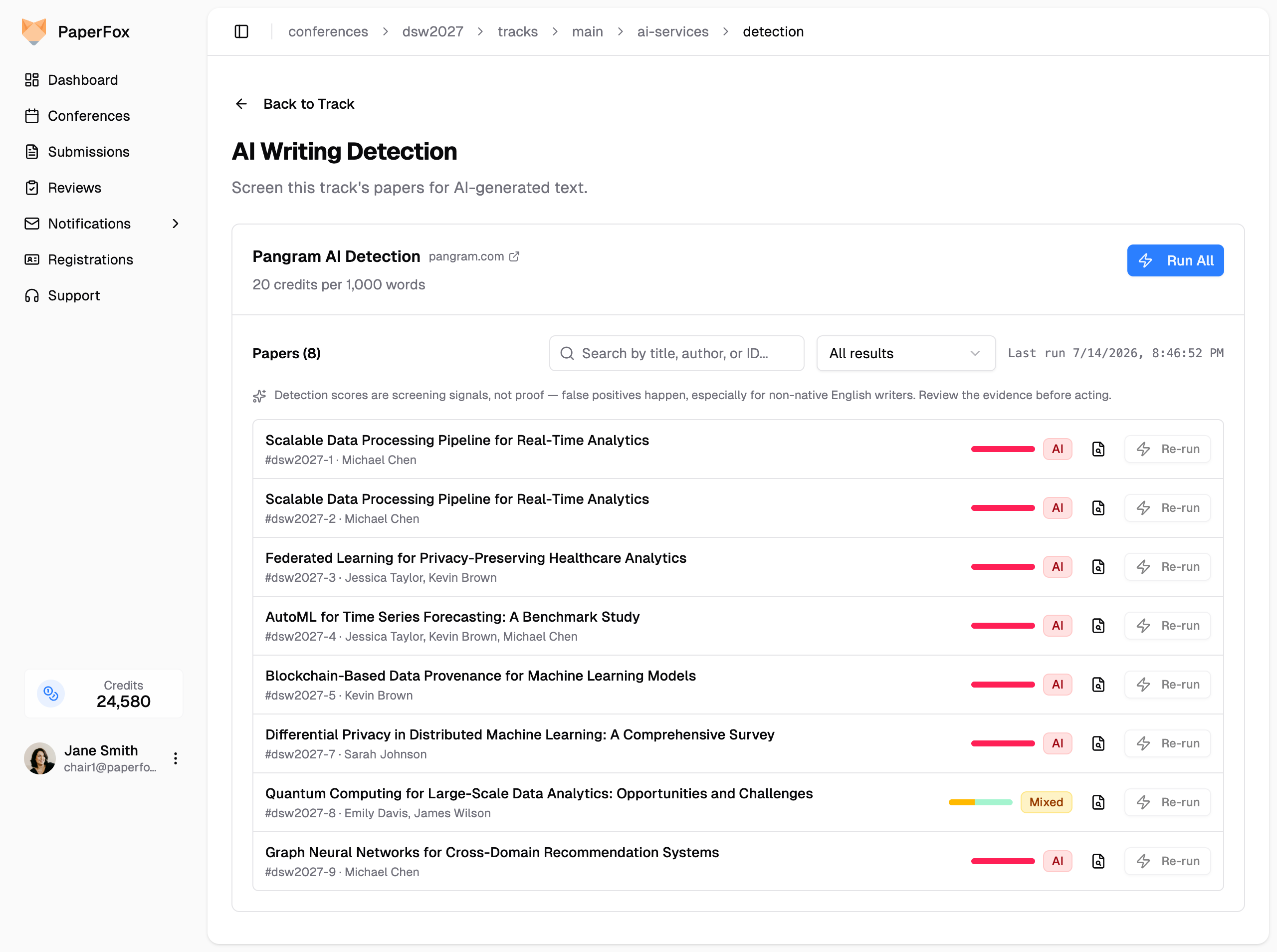
- Click "Run All" on the service card — or click "Run" / "Re-run" on any individual paper's row to analyze just that paper
- The confirmation dialog shows the estimated cost — an exact figure from the paper's measured word count for a single paper, an approximate total for Run All — and reminds you that paper text is sent to the external provider. Confirm to start
The analysis runs in the background with a progress bar — a typical track finishes in under a minute. You can keep working or cancel the run; cancelling refunds any papers that weren't analyzed, while papers that already finished keep their results and their charges.
Multiple File Fields
If your submission form has more than one file upload field (for example a manuscript plus an appendix), a Paper field selector appears above the service cards — pick which field's upload gets analyzed. Papers without an upload in the selected field are skipped, never billed. Forms with a single file field need no configuration.
Multi-Phase Tracks
If your track has more than one phase, a Phase selector appears above the service cards. The run analyzes each submission's latest version in the selected phase; submissions with no version in that phase are not included. Single-phase tracks hide the selector.
Reviewing Results
The Papers list on each service card shows every paper in scope with its latest result — single-paper re-runs simply refresh that paper's row. On large tracks, use the search box (title, author, or paper ID) and the result filter next to it (All / AI / Mixed / Human / Skipped / Not analyzed, with live counts) to narrow the list; the two combine. Verdicts:
| Verdict | Meaning |
|---|---|
| AI (red) | Most of the text looks AI-generated |
| Mixed / AI-Assisted (amber) | Parts of the text look AI-generated or AI-edited |
| Human (green) | The text looks human-written |
Each analyzed row also shows:
- Composition bar — how much of the text looks AI-generated (red), AI-assisted (amber), and human (green); hover for exact percentages
- Evidence — click the magnifier icon to see the full composition breakdown and the flagged passages
- Version badge — if the paper has been revised since the run, the row shows which version was analyzed so you know the result may be outdated
- Skipped / Failed — papers without a PDF, with unreadable files, or stopped by an empty balance; failed-after-charge papers are refunded automatically
Viewing Evidence
Click the magnifier icon on any analyzed row to see the paper's full composition and exactly which passages were flagged, each with its own label, score, and confidence level. Long passages are collapsed — click "Show full passage" to expand:
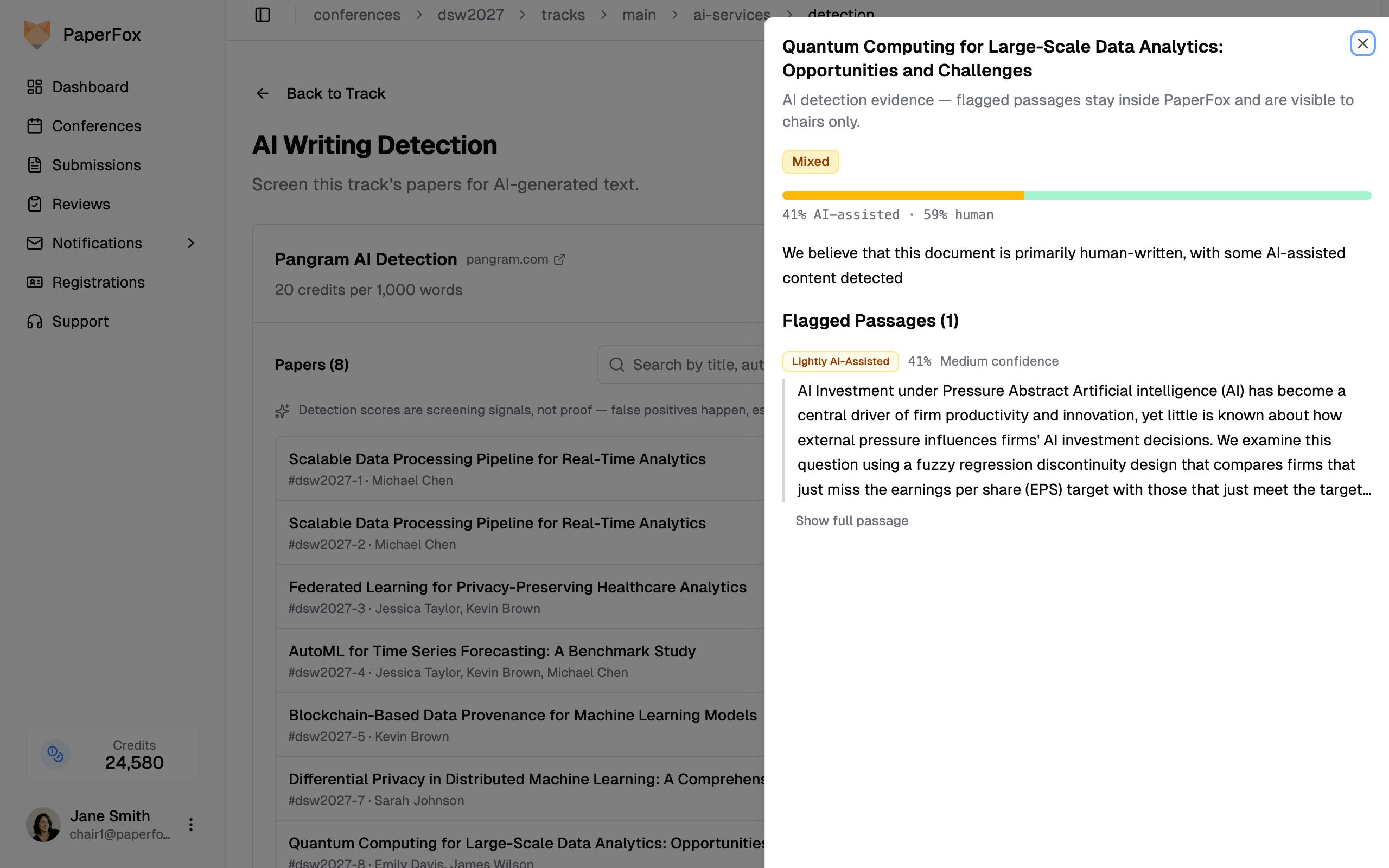
Papers with a Human verdict have no flagged passages — the evidence panel simply confirms nothing was flagged.
No public result pages
PaperFox never requests shareable result links from the provider — a public link would expose the paper's text to anyone with the URL. All evidence stays inside PaperFox, visible to chairs only.
Detection is a signal, not proof
AI detectors have known false-positive risks — especially for non-native English writers. Treat scores as a screening signal that tells you where to look, and never make decisions on the score alone.
Re-running the service refreshes results for papers that changed and reuses earlier results for papers that didn't — you're only billed for what's actually re-analyzed. Only one run per service can be active on a track at a time.